AEO - Answer Engine Optimization
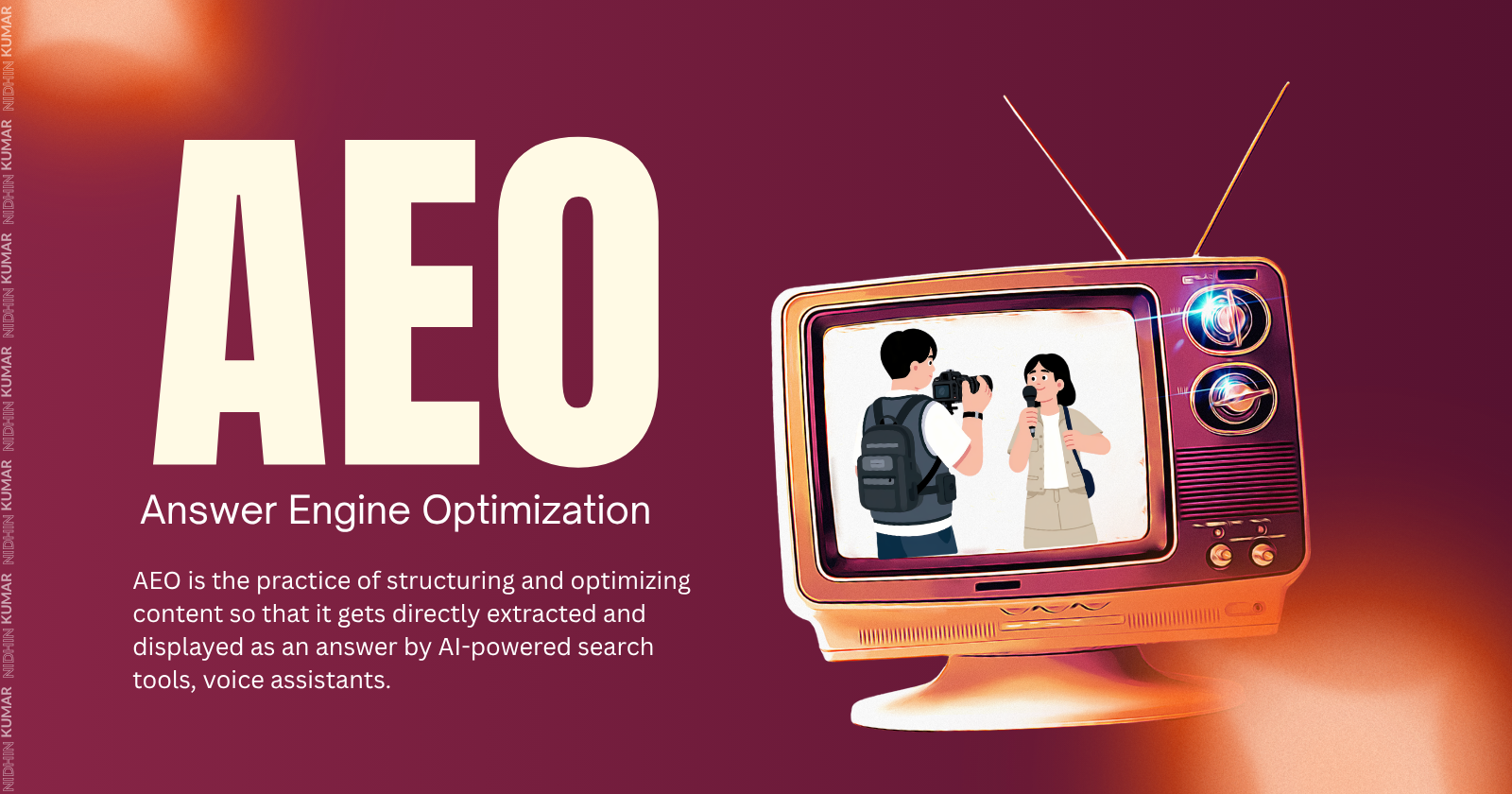
For twenty years, the game was simple: rank on page one, capture the click, convert the visitor. That game is changing fast.
In 2026, a huge share of searches never produce a click at all. People ask a question, an AI system — Google's AI Overview, ChatGPT, Perplexity, Copilot — reads across the web, and hands back a synthesized answer right there. If your content isn't the thing the AI decided to quote or cite, it doesn't matter how well you'd have ranked in the old ten-blue-links world. This is the shift Answer Engine Optimization (AEO) is built to address.
What AEO Actually Means
AEO is the practice of structuring content so that AI-driven "answer engines" can easily extract it, trust it, and use it as the basis for a direct answer — with or without a citation back to your site.
Where SEO asks "how do I rank for this keyword," AEO asks "how do I become the paragraph an AI decides to quote." It's a narrower, sharper target: not the whole page, just the specific claim, definition, comparison, or number that answers a specific question well enough that a model prefers it over every other source it read.
SEO and AEO aren't rivals — they're stacked. SEO gets your content crawled, indexed, and considered in the first place. AEO determines whether, once considered, it actually gets picked.
SEO vs. AEO: The Shift in Strategy
SEO and AEO aren't competitors—they build on top of each other.
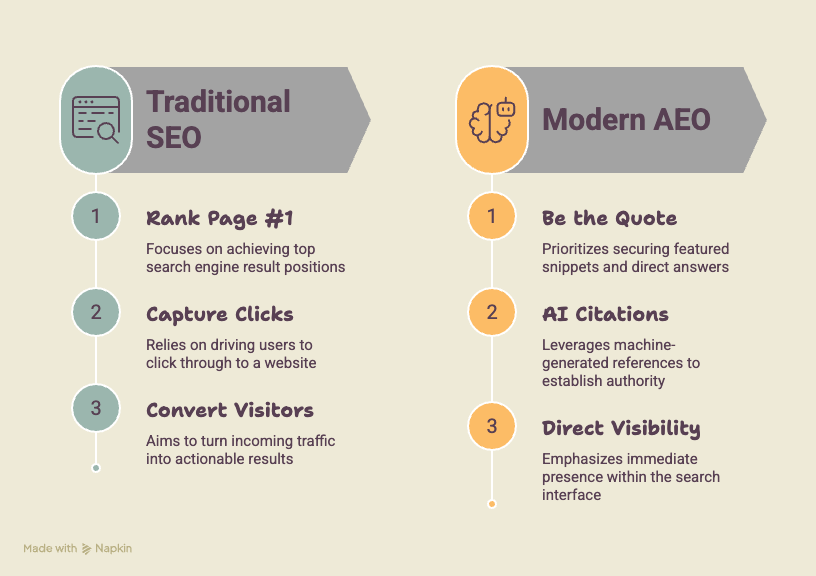
Dimension | Search Engine Optimization (SEO) | Answer Engine Optimization (AEO) |
Core Goal | Rank on page 1 for keywords | Become the source AI quotes in summaries |
Target | The whole web page | Specific, direct paragraphs or answers |
Success Metric | High Click-Through Rate (CTR) | Brand mentions, citations, & Share of Voice |
User Path | Search \(\rightarrow\) Click Link \(\rightarrow\) Read | Ask Question \(\rightarrow\) Read AI Answer \(\rightarrow\) Done |
Why It Matters Now
A few numbers explain the urgency
AI-generated summaries now show up on a large majority of searches that contain ten or more words, and an even larger share of searches that start with a question word.
Tools like ChatGPT and Google's AI Overviews are processing hundreds of millions to billions of queries a week between them.
Research tracking AI citation patterns has found that for commercial and evaluation-stage queries, the overwhelming majority of citations go to pages updated within the last year — and a majority of those were refreshed in just the last six months.
How Answer Engines Actually Choose
Language models don't "rank" content the way a search index does. When generating an answer, they pull from whatever passages best satisfy a few implicit criteria
Clarity of the answer itself — is there a clean, self-contained sentence or paragraph that directly resolves the question, or is the answer buried in throat-clearing and marketing fluff?
Evidence and specificity — does the claim come with a number, a source, a concrete example, rather than a vague assertion?
Topical depth — does the surrounding content suggest the page (and the site) genuinely knows this subject, or is it a thin, keyword-stuffed page chasing traffic?
Credible authorship and entity clarity — is it clear who wrote this, are they/the brand a recognizable, consistent entity across the web?
Freshness — has this been updated recently enough to reflect current facts?
Pages that bury the answer three paragraphs deep, that don't source their claims, or that haven't been touched in two years, tend to lose out to sources that make all of this easy.
Practical Tactics That Actually Move the Needle
Lead with the answer. Put the direct, quotable answer in the first sentence or two of a section — not at the end of a long narrative windup. Answer engines favor content that states its conclusion up front and then supports it.
Use structure the way machines read it. Clear H2/H3 headers phrased as actual questions, short paragraphs, bulleted comparisons, and tables all make it easier for a model to isolate a clean, extractable chunk of text. This is sometimes called "machine chunking" — writing in units that can be lifted out and used independently.
Back claims with real evidence. A statistic with a source, a named example, or a specific number will get chosen over a generic claim almost every time.
Add structured data where it reflects real content. FAQPage, HowTo, Article, and Organization/Person schema help engines confirm what a page is and who stands behind it — but only when the markup matches what's actually visible on the page. Schema layered onto hidden or exaggerated content tends to backfire.
Keep it current. Revisit high-intent pages on a real cadence — not "set and forget." Stale pages lose citation share to competitors who update more often, even when the underlying facts haven't changed much.
Build genuine topical authority. One well-optimized page rarely wins on its own. A cluster of interlinked, consistently authored content on a subject signals the depth that both search engines and AI models reward.
Track citations, not just rankings. Traditional rank tracking doesn't tell you whether ChatGPT or Google's AI Overview is actually quoting you. Newer AI-visibility tools monitor citation frequency and share of voice across these engines directly — worth adding to your reporting if AEO is now part of the strategy.
The Bigger Picture
AEO isn't a trick for gaming a new algorithm — it's a response to a real change in how people get information. The brands and writers who treat "being the answer" as seriously as they once treated "being the top link" are the ones who'll stay visible as more of the internet's traffic gets mediated by AI systems instead of search result pages.
The core discipline is the same as it's always been: be genuinely clear, be genuinely credible, and be genuinely current. AEO just makes explicit what good content should have been doing all along.
Popular AEO Tools
Tracking AI visibility requires different software than traditional rank trackers:
Tool Name | Best For | Key Features |
Ahrefs Brand Radar | Search-based AI tracking | Tracks brand mentions across 470M+ real search prompts. |
HubSpot AEO Grader | Quick initial assessment | Free single-lookup tool to audit current AI readiness. |
Profound AI | Enterprise tracking | Multi-engine analytics, conversation trends, & citation tracking. |
SE Ranking / SE Visible | Combined SEO & AEO | Tracks AI Overviews, ChatGPT, Perplexity, and competitor share of voice. |