Content Management System (CMS)

In this post, we will see the following about Content Management Systems (CMS)
What is a Content Management System
What makes up a Content Management System
Headless CMS Vs Traditional CMS
Popular Content Management Systems
1. What is a Content Management System
A Content Management System (CMS) is software that helps users to create, manage and modify content on a website without the need for specialized technical knowledge.
In simpler language, a content management system is a tool that helps you build a website without needing to write all the code from scratch
Instead of building your system for creating web pages, storing images, and other functions, the content management system handles all that basic infrastructure stuff for you so that you can focus on more forward-facing parts of your website.
2. What makes up a Content Management System
On a more technical level, a content management system is made up of two core parts
A content management application (CMA) — this is the part that allows you to actually add and manage content on your site
A content delivery application (CDA) — this is the backend, behind-the-scenes process that takes the content you input in the CMA, stores it properly, and makes it visible to your visitors.
3. Headless CMS Vs Traditional CMS
Headless CMS
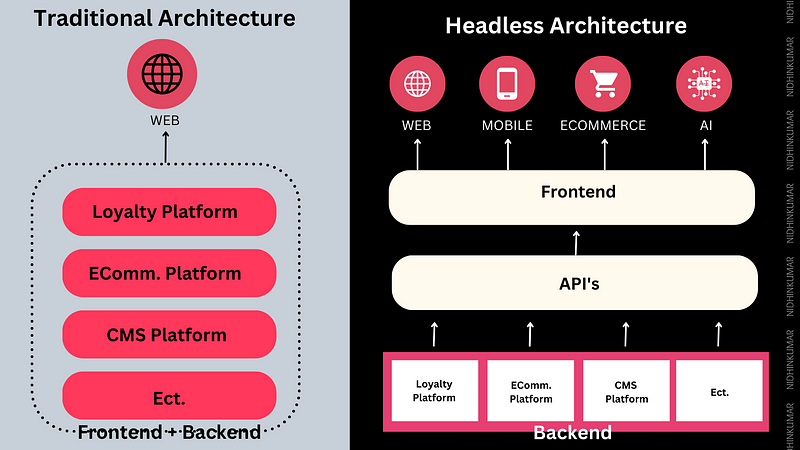
A headless CMS is a content management system where the front end and back ends are separated from each other. With headless CMSs, the stored content is made available to developers through APIs.
Headless CMSs are frontend agnostic and API-driven by design. This way, developers are free to deliver the content to their audience with the frameworks and technologies of their choice.
Traditional CMS
A traditional CMS is a monolithic content delivery system. With a traditional CMS, the front end and back end are coupled together.
4. Popular Content Management Systems
#1 Acquia.com
Hosting for Drupal sites. Free tier for developers. Free development tools (such as Acquia Dev Desktop) are also available
#2 Contentful
Headless CMS. Content management and delivery APIs in the cloud. Comes with one free Community space that includes 5 users, 25K records, 48 Content Types, and 2 locales.
#3 Cosmic
Headless CMS and API toolkit. Free personal plans for developers.
#4 Crystalize
Headless CMS with e-commerce support. Built-in GraphQL API. The free version includes unlimited users, 1000 catalog items, 5 GB/month bandwidth, and 25k/month API calls.
#5 DatoCMS
Offers free tier for small projects. DatoCMS is a GraphQL-based CMS. On the lower tier, you have 100k/month calls.
#6 Directus
Headless CMS. A completely free and open-source platform for managing assets and database content on-prem or in the Cloud. No limitations or paywalls.
#7 Forestry.io
Headless CMS. Give your editors the power of Git. Create and edit Markdown-based content with ease. Comes with three free sites that include 3 editors, Instant Previews. Integrates with blogs hosted on Netlify/GitHubpages/ elsewhere
#8 FrontAid
Headless CMS that stores JSON content directly in your own Git repository. No restrictions.
#9 Kontent.ai
A Content-as-a-Service platform that gives you all the headless CMS benefits while empowering marketers at the same time. The developer plan provides 2 users with unlimited projects with 2 environments for each, 500 content items, 2 languages with Delivery and Management API, and Custom elements support. Larger plans were available to meet your needs.
#10 Prismic
Headless CMS. Content management interface with fully hosted and scalable API. The Community Plan provides 1 user with unlimited API calls, documents, custom types, assets, and locales. Everything that you need for your next project. Bigger free plans are available for Open Content/Open Source projects.
#11 Sanity.io
A platform for structured content that comes with an open-source editing environment and a real-time hosted data store. Unlimited projects. Unlimited admin users, 3 non-admin users, 2 datasets, 500K API CDN requests, 10GB bandwidth, and 5GB assets included for free per project.
#12 Sensenet
API-first headless CMS provides enterprise-grade solutions for businesses of all sizes. The Developer plan provides 3 users, 500 content items, 3 built-in roles, 25+5 content types, fully accessible REST API, document preview generation, and Office Online editing.
#13 Gatsby
Gatsby is a fast and flexible framework that makes building websites with any CMS, API, or database fun again. Build and deploy headless websites that drive more traffic, convert better, and earn more revenue!
#14 GraphCMS
Offers free tier for small projects. GraphQL first API. Move away from legacy solutions to the GraphQL native Headless CMS — and deliver omnichannel content API first.
#15 Squidex
Offers free tier for small projects. API / GraphQL first. Open source, and based on event sourcing
Congratulations!!
In this post, we have seen about CMS and its types and some of the popular CMS. Will catch up in yet another post with more crafts. Till then Happy Learning:)